xB
The box that put Scion on the map. Tall, square and endlessly customizable, it became the brand's calling card and a tuner-scene icon.
Discontinued after 2015
Scion was Toyota's experiment in reaching a generation that had grown up on import tuners, video games and mixtapes. It sold square cars at fixed prices, let buyers build their own, and turned a toaster-shaped hatchback into a cult icon. This is the full story of the marque, from concept stand to final badge swap.
By the late 1990s Toyota had a problem it could see in the data: its buyers were getting older, and the kids who grew up in the back seat of their parents' Camry were not coming back to buy one. An earlier youth push under the Toyota badge had not moved the needle, so the company tried something more radical — a separate marque, developed under the internal name Project Exodus.
Toyota itself later described Scion as a "test laboratory" division of Toyota Motor Sales U.S.A. The name meant a descendant or heir, and it was meant to describe both the cars and the people who bought them.
Scion was revealed to the public at the New York International Auto Show in March 2002, with concept cars previewing a tall, boxy wagon and a compact hatch. Fifteen months later, on June 9, 2003, the first Scions went on sale at 105 Toyota dealerships in California. The brand went nationwide by February 2004.
Scion debuts at the New York International Auto Show with concepts previewing its first cars.
The xA and xB go on sale at 105 Toyota dealers in California. The xA starts at $12,965, the xB at $14,165. Scion sells 10,898 cars in its first half-year.
Scion reaches all 50 states by February. The tC sports coupe joins the lineup and becomes the brand's biggest seller to young buyers. Sales jump to 99,259.
173,034 Scions sold — the best year the brand would ever have.
A bigger, more powerful xB arrives for 2008, and the xD replaces the xA in August 2008. Sales cool as the economy slides into recession.
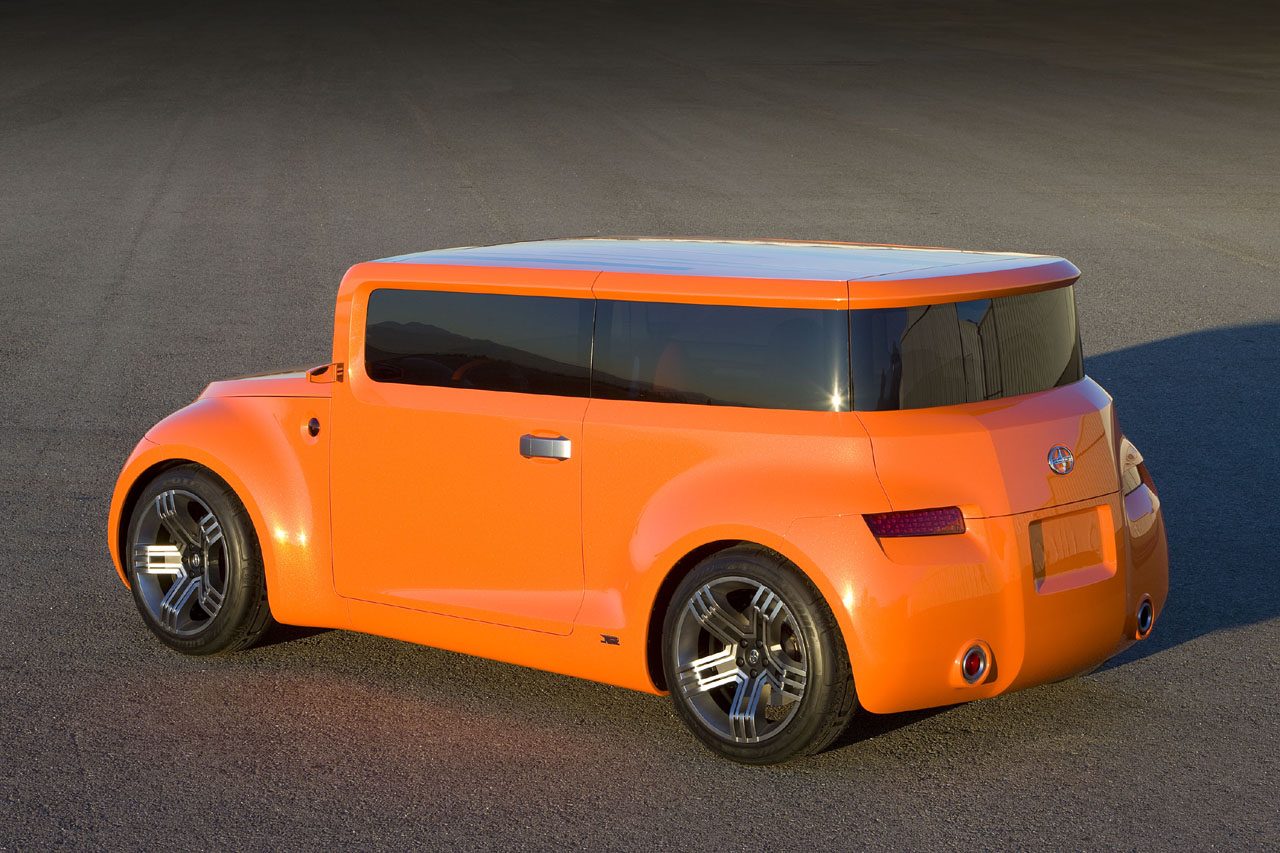
At the New York International Auto Show, Scion shows the Hako Coupe: an xB-inspired box restyled by Toyota's Tokyo design studio after classic American coupes. "Hako" is Japanese for box.
Sales bottom out at 45,678 while Scion expands north into Canada.
The 2012 iQ micro city car goes on sale in October, one of the shortest cars sold in America.
A rear-wheel-drive sports coupe, co-developed with Subaru, gives enthusiasts a reason to look at Scion again. More than 18,000 buyers took one home in 2013.
The iA sedan and iM hatchback arrive for the 2016 model year with the "Weird, Right?" campaign. The original xB line ends.
Toyota says Scion will be phased out, explaining it no longer needs a separate marque to reach younger buyers.
The tC bows out with a final Release Series. Starting with the 2017 model year, surviving Scions wear Toyota badges.
Eight nameplates in thirteen years, most of them sourced from Toyota's Japanese domestic market and re-imagined for American roads.
The box that put Scion on the map. Tall, square and endlessly customizable, it became the brand's calling card and a tuner-scene icon.
Scion's entry-level car and its lowest price at launch. Simple, light and frugal, it shared its platform with the xB.
A two-door with a panoramic glass roof and a big four-cylinder. Scion's best seller with young buyers, it ran two generations to the very end.
The xA's successor: a chunkier, more muscular subcompact with a 1.8-liter engine and a cheeky stance.
Under ten feet long yet able to seat four in a pinch, the iQ was clever packaging aimed squarely at the city.
"Front-engine, Rear-wheel drive, Sport." A boxer-powered, lightweight coupe built with Subaru that won over the track-day crowd.
A Mazda-built sedan with a sharp chassis and a fuel-sipping engine, sold with Scion's familiar one-price approach.
A well-equipped European-market hatchback brought stateside as Scion's last new model.
No car defined Scion like the xB. Critics called it a toaster. Owners called it a blank canvas. It was the car you could fit a full sound system, five friends and a weekend's worth of gear into, and still park anywhere.
Adapted from a Japanese-market Toyota, the first xB was small, upright and almost architectural. Its tiny footprint hid a surprisingly huge cabin, and its light weight and low price made it a favorite first car and an easy platform to modify.
For 2008 the xB got bigger, heavier and much stronger, trading the original's buzz for real highway manners. It kept the square silhouette but softened the edges, and ran largely unchanged until the nameplate ended after 2015.
Two decades on, the xB still turns up at shows, meets and track days, often wearing wheels, suspension and audio setups its designers never imagined. That is exactly the point — and why this site carries its name.
A fast rise, a 2006 peak, and a long plateau after the recession. U.S. sales by calendar year:
2003 – 2015 figures from Toyota's Scion fact sheet (Feb. 2016). 2016 figure from GoodCarBadCar. 2003 covers June – December only.
Scion spent less on traditional advertising and more on being part of the scene. Its buyers were among the youngest in the industry, and the brand met them where they already were.
Scions arrived at the height of the import-tuner era, and they were built to be modified. Factory-backed show builds became a fixture at SEMA, and owners' clubs sprang up across the country.
The tC and FR-S earned their stripes in drifting and grassroots racing, and the FR-S made affordable rear-wheel-drive track days a reality for a new generation.
Scion sponsored artists, gallery shows and its own music releases, positioning the badge as a patron of the culture rather than just an advertiser to it.
Scions showed up in racing games of the era, putting the cars in front of players long before they were old enough to buy one.
Numbered, limited-run editions in exclusive colors gave collectors something to chase — and many are sought-after today.
Pure Price made buying a car feel transparent and approachable, an idea that later spread well beyond Scion.
Scion's early success was hard to sustain. The first-generation cars were hits, but the larger second-generation models lost some of the original charm, and the 2008 recession hit the brand's young, price-sensitive buyers hard. By 2010 annual sales were barely a quarter of the 2006 peak. Long gaps between new products didn't help.
When Toyota pulled the plug in 2016, it framed the decision as a success: Scion had done its job as a laboratory. Lessons about younger buyers, no-haggle pricing and personalization would be carried into Toyota itself. Toyota said roughly half of Scion's buyers over its life were under 35, and most were new to Toyota.
For enthusiasts, the legacy is simpler: a generation of affordable, modifiable cars that are still out there being built, shown and driven.
This lookback is brought to you by two crews who still build, show and drive cars like the ones Scion made famous.
A private, state-licensed automotive facility for technology, modifications and specialty repairs. Every build runs through Ignition, New Speed's five-stage process: profile, build sheet, parts, build and shakedown. By appointment only.
Visit New Speed Auto Call the Tech Lab · (850) 571-7037TOCC bills itself as the world's friendliest car enthusiast club: a private club organized into make-specific teams, from Twisted Tuners and Dropped Dubs to its own Scion crew, the Sic Scions. Members show, race and give back to the community, and get a streamlined build path through New Speed Automotive.
Visit TOCC Join TOCCPower and speed belong on the track. New Speed Automotive and Tricked Out Car Club do not support street racing — Stop Street Racing.